
Japan Energy Update: Battery Storage Enters Its Infrastructure Phase
- LPA Administrative Scrivener Corporation

- Jul 2
- 3 min read

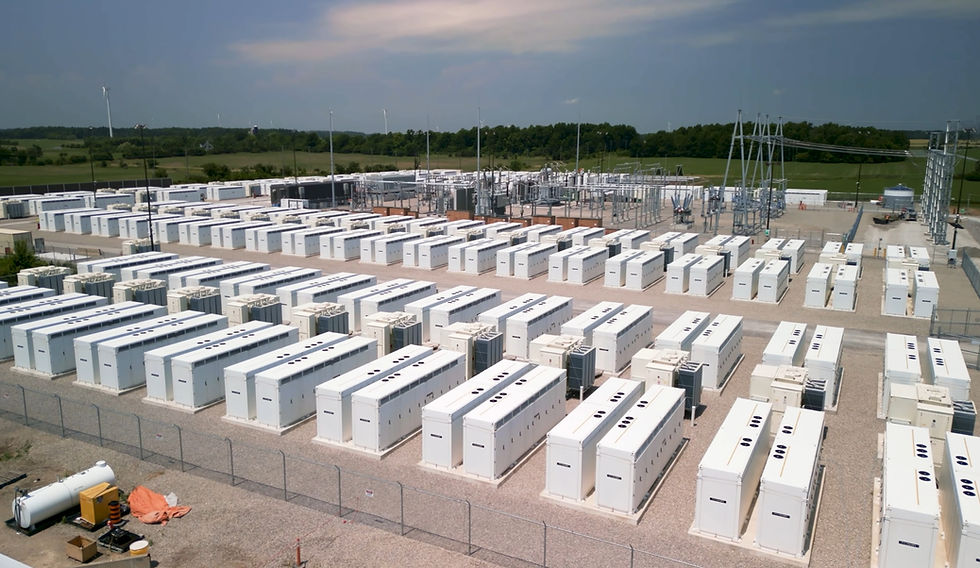
Japan’s battery storage sector has seen important policy and market developments over the past month. Recent announcements suggest that battery energy storage systems (“BESS”) are moving beyond pilot projects and subsidy-driven initiatives, and are increasingly being treated as long-term energy infrastructure assets.
For companies and investors, this creates opportunities, but also raises practical legal and commercial issues, including land rights, grid connection, project financing, battery procurement, safety standards, operation and maintenance, and revenue structure.
1. METI Revises Japan’s Battery Strategy
On 2 June 2026, the Ministry of Economy, Trade and Industry of Japan (“METI”) announced that the former “Battery Industry Strategy” had been revised into the broader “Battery and Power Industry Strategy.” The revision was considered within the Battery Industry Strategy Promotion Council and reflects changes in the environment surrounding Japan’s battery industry, including global oversupply, supply chain risks, and growing demand for advanced power-control solutions for AI data centers, medical facilities and disaster-prevention infrastructure.
The revised strategy shows that Japan is looking beyond battery manufacturing alone. It positions batteries as part of a wider power-system strategy covering energy control, stationary storage, resilience infrastructure, medical facilities, AI data centers and future power supply systems.
In connection with this revision, METI also updated the following three targets previously set under the Battery Industry Strategy:
Establishment of a domestic manufacturing base
Japan aims to establish domestic battery manufacturing capacity of 150 GWh per year between 2030 and the mid-2030s.
Securing global presence
Japan aims to triple Japanese companies’ battery-related sales in the global market between 2025 and 2035.
Capturing the next-generation battery market
Japan aims to achieve full-scale practical use of all-solid-state batteries around 2030, and to establish a manufacturing base corresponding to demand scale toward the mid-2030s.
2. New Project Developments
Recent project announcements also show that BESS projects in Japan are becoming larger and more structured.
A key example is the business alliance announced on 22 June 2026 between TEPCO Holdings and Daiwa House Industry for the co-development of grid-connected battery storage stations across Japan. The companies are targeting a total output of 1 GW and storage capacity of 4 GWh by 2035. Under the planned structure, Daiwa House will mainly handle land acquisition, development, design and construction, while the TEPCO group will handle battery procurement, electrical works, maintenance, operation and market transactions. The companies also refer to the possible use of special purpose companies and external investors for individual projects.
Other recent announcements indicate that the market is gradually moving beyond the standard small-scale 2 MW / 8 MWh model. These include the 67 MW / 230.1 MWh Chikuzen project in Fukuoka Prefecture, involving PowerX, Mitsubishi Estate, Itochu and Tokyo Century, and two large-scale BESS projects in Nagano Prefecture involving SMFL Mirai Partners, Fujimaki Construction and Toshiba Plant Systems & Services, with a combined scale of approximately 84.4 MW / 250.75 MWh.
These developments suggest that the Japanese BESS market is entering a new phase. Successful projects will require not only battery procurement, but also land control, grid-connection capability, financing, technical operation and clear contractual allocation of risk.
3. Legal and Commercial Points for Foreign Companies
For foreign battery manufacturers, developers, investors, aggregators and technology providers, BESS projects should be assessed as infrastructure projects. The key issues will be project viability, regulatory feasibility and risk allocation.
In practice, early-stage due diligence should cover land rights, grid access, regulatory requirements under the electricity business framework, permitting and safety requirements, revenue assumptions, and whether construction, operation and maintenance arrangements are sufficiently robust.
Where projects are structured through special purpose companies or involve external investors, attention should also be paid to shareholder arrangements, security packages and regulatory compliance, including any applicable Foreign Exchange and Foreign Trade Act filing requirements.
4. Takeaway
Japan is actively positioning battery storage as a core component of its future energy infrastructure.
The past month confirms three important trends: Japan’s battery policy is expanding from manufacturing to integrated power systems; larger and more structured BESS projects are emerging; and successful project development will increasingly depend on land control, grid access, safety, technical reliability, operation and financing.
For foreign companies and investors, the opportunity is significant. However, market entry should be supported by careful legal, regulatory and technical due diligence from an early stage.

Comments